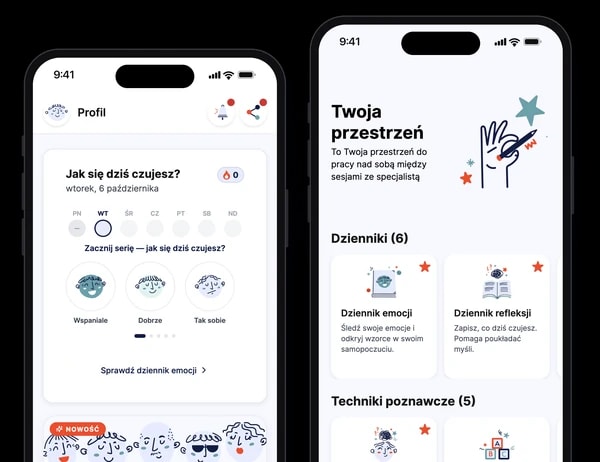
Aplikacja TwójPsycholog — wsparcie, które masz zawsze pod ręką
- Umów lub przełóż wizytę w kilka sekund
- Buduj zdrowe nawyki z asystentem AI
- Korzystaj z bezpłatnych biblioteki materiałów i ćwiczeń
📲 Pobierz aplikację i zadbaj o siebie na własnych zasadach
dr Monika Boberska
Psycholożka
- Doświadczenie

- Usługi

- Opinie

- Kontakt

Kluczowe informacje
Miejsce spotkań
-
Wiek
-
Przyjazny LGBT+
Tak
Język terapii
polski
Doświadczenie zawodowe
9 lat
Praca z osobami głęboko wierzącymi
Tak
Praca pod stałą superwizją
Tak
dr Monika Boberska - o mnie
czytaj więcejSpecjalizacja
Rodzaje terapii
- Dla dzieci i młodzieży
- Indywidualna
- Rodzinna
Obszary pomocy
Odżywianie się
Obszar skupiony na zaburzeniach odżywiania się, jak również na diecie i zdrowym, służącym podejściu do żywienia. Obejmuje zarówno choroby, które wymagają interwencji specjalisty zdrowia psychicznego, jak też wsparcie i psychoedukację w temacie odżywiania się.
Obszary
- Zmiana nawyków żywieniowych
Zaburzenia neurorozwojowe
Obszar obejmujący zarówno całościowe zaburzenia rozwojowe, jak też zaburzenia neurorozwojowe, skupienia uwagi i koncentracji. Rozpoczynają się one w dzieciństwie i polegają głównie na trudnościach w komunikacji, kontaktach społecznych, wykonywanych zadaniach, czy związane są z nietypowymi zachowaniami. Nie jest to choroba, którą się leczy, a styl zachowania, który wspiera się odpowiednimi oddziaływaniami.
Obszary
- ADHD
- Niepełnosprawność intelektualna
- Specyficzne zaburzenia uczenia się (np. dysleksja, dysgrafia, dyskalkulia)
- Spektrum zaburzeń autystycznych (ASD)
Kryzysy
Obszar ostrych, przejściowych zmian, które zakłócają stabilną równowagę psychiczną i powodują cierpienie psychiczne. Kryzys powstaje wtedy, gdy sytuacja, przekracza możliwości i dotychczasowe strategie radzenia sobie. Przedłużający się kryzys, może prowadzić do zaburzeń i chorób psychicznych. Można wyróżnić kryzys sytuacyjne, rozwojowe, egzystencjalne czy środowiskowe.
Obszary
- Diagnoza onkologiczna
- Kryzys wieku średniego
- Myśli samobójcze
- Rozwód / rozstanie
- Samotność
- Starość
- Trudność w znalezieniu partnera/ki
- Utrata sensu życia
- Żałoba
Pokaż więcej
Moje doświadczenie
Edukacja
- Uniwersytet SWPS (Dr Nauk Społecznych, 2020)
- Uniwersytet SWPS (Magister Psychologii, 2015
- Dolnośląska Szkoła Wyższa (Przygotowanie Pedagogiczne, 2015)
Doświadczenie
- Psycholog, Cognito Centrum Zdrowia Psychicznego i Rozwoju we Wrocławiu
- Adiunkt, Uniwersytet SWPS, filia we Wrocławiu
- Psycholog, Dzienny Ośrodek Psychiatrii i Zaburzeń Mowy dla Dzieci i Młodzieży we Wrocławiu
Certyfikaty i szkolenia
- Kid’s Skills – Dam Radę oraz I’m Proud of You – Jestem z Ciebie Dumny, 2025
- MEDIACJE-szkolenie podstawowe, 2026
- Trener TUS, 2025
- Trener TUS osób w spectrum autyzmu, 2025
- Praktyczne aspekty pracy z pacjentem,
- Poradnictwo Psychologiczne w praktyce, 2013
Publikacje
- Boberska, M., Wietrzykowska, D., Kulis, E., Kuzminska, J., Zalewska-Lunkiewicz, K., Karaglani, E., Mourouti, N., Manios, Y., Luszczynska, A., & MELIORA Consortium. (2026).Which combinations of behaviour change techniques work best? Evidence from meta-review of interventions addressing healthy diet and exercise after breast cancer. International Journal of Behavioral Nutrition and Physical Activity. https://doi.org/10.1186/s12966-026-01961-6
- Boberska, M., Wietrzykowska, D., Kulis, E., Kuzminska, J., Zalewska-Lunkiewicz, K., Karaglani, E., Mourouti, N., Manios, Y., Luszczynska, A., & MELIORA Consortium. (2026). Behaviour change techniques used in effective interventions, promoting physical activity, healthy nutrition, and healthy body mass among women with breast cancer and breast cancer survivors: A meta-review. Health Psychology Review, 20(2), 357–385. https://doi.org/10.1080/17437199.2025.2592667
- Lobczowska, K., Kulis, E., Banik, A., Siwa, M., Boberska, M., Szczuka, Z., Zaleskiewicz, H., Wietrzykowska, D., Krzywicka, P., Misiakowska, J., Kornafel, A., Kuzminska, J., Paduszynska, N., Zalewska-Lunkiewicz, K., & Luszczynska, A. (2025). Implementers’ 5 perceptions of barriers and facilitators in the implementation setting is associated with physical activity changes among participants of a planning intervention, Psychology & Health, 1–19. https://doi.org/10.1080/08870446.2025.2496239
- Wietrzykowska, D., Krzywicka, P., Szczuka, Z., Kulis, E., Siwa, M., Kornafel, A., Zaleskiewicz, H., Boberska, M., Banik, A., Misiakowska, J., Knoll, N., Radtke, T., Rhodes, R. E., & Luszczynska, A. (2025). Tell me where you live, and I will predict your exercise levels: How self-regulatory action control, objective and perceived physical environment jointly explain physical activity time. British Journal of Health Psychology, 30, e70011. https://doi.org/10.1111/bjhp.70011
- Kulis, E., Szczuka, Z., Banik, A., Siwa, M., Boberska, M., Zarychta, K., Zaleskiewicz, H., Knoll, N., Radtke, T., Scholz, U., Schenkel, K., & Luszczynska, A. (2025). Physical activity planning interventions, body fat and energy-dense food intake in dyads: ripple, spillover, or compensatory effects?. Psychology & health, 40(3), 433–453. https://doi.org/10.1080/08870446.2023.2233001
- Siwa, M., Banik, A., Szczuka, Z., Kulis, E., Boberska, M., Wietrzykowska, D., Knoll, N., DeLongis, A., Knäuper, B., & Luszczynska, A. (2025). Provided and received positive and negative social control, relationship satisfaction, and sedentary behavior in parent-child dyads. Annals of Behavioral Medicine, 59(1), kaae092. https://doi.org/10.1093/abm/kaae092
- Szczuka, Z., Kulis, E., Banik, A., Boberska, M., Siwa, M., Zaleskiewicz, H., Krzywicka, P., Paduszynska, N., Knoll, N., Radtke, T., Schenkel, K., Dunton, G. F., & Luszczynska, A. (2024). Effects of physical activity planning interventions on reducing sedentary behavior in parent-child dyads: A randomized controlled trial. Applied Psychology. Health and Well- Being, 16(4), 1840–1863. https://doi.org/10.1111/aphw.12565
- Kulis, E., Szczuka, Z., Banik, A., Siwa, M., Boberska, M., Wietrzykowska, D., Zaleskiewicz, H., Rhodes, R. E., Radtke, T., Schenkel, K., Knoll, N., Scholz, U., & Luszczynska, A. (2024). Individual, dyadic, collaborative planning, physical activity, and nutrition: A randomized controlled trial in parent-child dyads. Health psychology : official journal of the Division of Health Psychology, American Psychological Association, 10.1037/hea0001405. Advance online publication. https://doi.org/10.1037/hea0001405
- Szczuka, Z., Kulis, E., Boberska, M., Banik, A., Siwa, M., Zaleskiewicz, H., ... & Luszczynska, A. (2023). Dyadic reciprocal associations between self‐efficacy and planning predict sedentary behaviour. British Journal of Health Psychology, 28(2), 451-466. https://doi.org/10.1111/bjhp.12633
- Kulis, E., Szczuka, Z., Banik, A., Siwa, M., Boberska, M., Zarychta, K., ... & Luszczynska, A. (2023). Physical activity planning interventions, body fat and energy-dense food intake in dyads: ripple, spillover, or compensatory effects?. Psychology & Health, 1-21. https://doi.org/10.1080/08870446.2023.2233001
- Siwa, M., Szczuka, Z., Banik, A., Kulis, E., Boberska, M., Wietrzykowska, D., Knoll, N., DeLongis, A., Knäuper, B., & Luszczynska, A. (2023). The Dyadic Interplay Between Relationship Satisfaction, Perceived Positive and Negative Social Control, and a Reduction of Sedentary Behavior Time. Annals of Behavioral Medicine, 57(2), 165–174. https://doi.org/10.1093/abm/kaac032
- Siwa, M., Kulis, E., Banik, A., Szczuka, Z., Boberska, M., Wietrzykowska, D., Knoll, N., DeLongis, A., Knäuper, B., & Luszczynska, A. (2023). Associations between depressive symptoms and sedentary behaviors in dyads: Longitudinal crossover effects. Mental Health and Physical Activity, 24, 100501. https://doi.org/10.1016/j.mhpa.2022.100501
- Banik, A., Knai, C., Klepp, I., Rutter, H., Rito, A., Lien, N., Baillergeau, E., Szczuka, Z., Boberska, M., Kulis, E., & Luszczynska, A. (2023) What policies are there and what policies are missing? A Photovoice study of adolescents' perspectives on obesity-prevention policies in their local environment. Obesity Reviews, 24, e13617. https://doi.org/10.1111/obr.13617
- Kulis, E., Szczuka, Z., Banik, A., Siwa, M., Boberska, M., Knoll, N., Radtke, T., Scholz, U., Rhodes, R. E., & Luszczynska, A. (2022). Insights into effects of individual, dyadic, and collaborative planning interventions on automatic, conscious, and social process variables. Social Science & Medicine, 314, 115477. https://doi.org/10.1016/j.socscimed.2022.115477
- Swora, E., Boberska, M., Kulis, E., Knoll, N., Keller, J., & Luszczynska, A. (2022). Physical Activity, Positive and Negative Symptoms of Psychosis, and General Psychopathology among People with Psychotic Disorders: A Meta-Analysis. Journal of Clinical Medicine, 11(10), 2719. https://doi.org/10.3390/jcm11102719
- Boberska, M., Zarychta, K., Knoll, N., Keller, J., Hohl, D. H, Horodyska, K., Kruk, M., & Luszczynska, A. (2020). Maternal practices and perceptions of child body mass status explain child energy expenditure behaviors and body mass. Journal of Behavioral Medicine. https://doi.org/10.1007/s10865-020-00138-1
- Zarychta, K., Banik, A., Kulis, E., Boberska, M., Radtke, T., Chan, C. K. Y., Lobczowska, K., & Luszczynska, A. (2020). Do parent-child dyads with excessive body mass differ from dyads with normal body mass in perceptions of obesogenic environment? Nutrients, 12, 2149. https://doi.org/10.3390/nu12072149
- Radtke, T., Liszewska, N., Horodyska, K., Boberska, M., Schenkel, K., & Luszczynska, A. (2019). Cooking together: The IKEA effect on family vegetable intake. British Journal of Health Psychology, 24, 896-912. DOI: 10.1111/bjhp.12385
- Zarychta, K., Horodyska K., Gan, Y., Chan, C. K. Y., Wiggers, J., Wolfenden, L., Boberska, M., & Luszczynska, A. (2019). Associations of Parental and Child Food and Exercise Aversion With Child Food Intake and Physical Activity. Health Psychology, http://dx.doi.org/10.1037/hea0000799
- Zarychta, K., Banik, A., Kulis, E., Boberska, M., Radtke, T., Chan, C. K. Y., & Luszczynska, A. (2020). Parental depression predicts child body mass via parental support provision, child support receipt, and child physical activity: findings from parent/caregiver- child dyads. Frontiers in Psychology, 11, e161. https://doi.org/10.3389/fpsyg.2020.00161
- Kruk., M, Zarychta, K., Horodyska, K., Boberska, M., Scholz, U., Radtke, T., & Luszczynska, A, (2019). What comes first, negative emotions, positive emotions, or moderate-to vigorous physical activity? Mental Health and Physical Activity, 16, 38-42. https://doi.org/10.1016/j.mhpa.2019.03.002
- Boberska, M., Horodyska, K., Kruk, M., Knoll, N., Hohl, D. H., Keller, J., & Luszczynska, A. (2019). Parental strategies restricting screen use among children, screen home environment, and child screen use as predictors of child body fat: A prospective parent-child study. British Journal of Health Psychology, 24 , 298-314.https://doi.org/10.1111/bjhp.12354
- Horodyska, K., Boberska, M. Kruk, M., Szczuka, Z., Wiggers, J., Wolfenden, L., Scholz, U., Radtke, T., &. Luszczynska, A. (2019). Perceptions of physical activity promotion, transportation support, physical activity, and body mass: an insight into parent-child dyadic processes. International Journal of Behavioral Medicine, 26(3), 255-265. https://doi.org/10.1007/s12529-019-09780-9.
- Kruk, M., Zarychta, K., Horodyska, K., Boberska, M., Scholz, U, Radtke, T. i Luszczynska, A.(2019). From enjoyment to physical activity or from physical activity to enjoyment? Longitudinal associations in parent-child dyads. Psychology & Health. DOI: 10.1080/08870446.2018.1489049
- Luszczynska, A., Kruk, M., & Boberska, M. (2018). Measurement in health psychology research. In T. A. Revenson, & A. R. Gurung (Eds.), The Handbook of Health Psychology, (3rd edition). New York: Taylor & Francis. (Chapter 4).
- Zarychta, K., Kruk, M., Boberska, M. Szczuka, Z., Horodyska, K., Kulis, E., Luszczynska, A. (2018). Depresja wśród elity sportowców: systematyczny przegląd badań. Przegląd psychologiczny.
- Kruk, M., Blecharz, J., Boberska, M., Zarychta, K., I Luszczynska, A. (2017). Mental strategies predict performance and satisfaction with performance among soccer players. Journal of Human Kinetics, 59, 79-90, doi:10.1515/hukin-2017-0149
- Horodyska, K., Boberska, M., Liszewska, N., Knoll, N., Scholz, U., Radke, T. Liszewska, N., i Luszczynska, A. (2017). What matters, parental or child perceptions of physical activity facilities? A prospective parent-child study explaining physical activity and body fat among children. Psychology of Sport & Exercise, 34, 39-45. doi:10.1016/j.psychsport.2017.09.007
- Boberska, M., Szczuka, Z., Kruk, M., Knoll, N., Keller, J., Hohl, D. H., & Luszczynska, A. (2018). Sedentary behaviors and health-related quality of life. A systematic review and meta- analysis. Health Psychology Review, 12, 195-210. doi: 10.1080/17437199.2017.1396191
- Banik, A., Luszczynska, A., Schwarzer, R., Pawlowska, I., Boberska, M., i Cieslak, R. (2017). Women with family cancer history are at risk for poorer physical quality of life and lower self-efficacy: A longitudinal study among men and women with non-small cell lung cancer. Health and Quality of Life Outcomes, 15, 62. DOI 10.1186/s12955-017-0645-5
Umów wizytę
Wybierz termin i miejsce wizyty